The EUR/USD currency pair traded with low volatility and a slight upward tilt over the past week. Overall, the market has made it clear that it is simply tired of responding to the constantly contradictory messages regarding the war in the Middle East. Donald Trump might announce one day that the parties are close to concluding a deal, only to issue new threats against Iran an hour later. Most of Trump's peace-loving and optimistic statements are contradicted by Tehran just a few hours later. Therefore, traders are left to guess at the current stage of negotiations between Iran and the United States.
Although the level of uncertainty is high, some things are known for certain. Iran remains unwilling to abandon its nuclear weapons and developments, which renders any negotiations fundamentally pointless. The United States will not abandon its goal of disarming Iran, while Iran will not give up its nuclear weapons. The purpose of these negotiations remains unclear. However, experts note that the parties may at least agree to a complete ceasefire and the reopening of the Strait of Hormuz, after which they could negotiate the "nuclear question" for up to 10 years. By the way, that's how long the negotiations for the previous nuclear deal lasted, from which Trump carelessly withdrew in order to later initiate a war against Iran.
Thus, this week the market will once again have to closely monitor geopolitics, separating the wheat from the chaff and sifting through tons of information, 90% of which is absolute trash. The macroeconomic and fundamental background continues to have practically no influence on market sentiment; however, we will still look at events that could hypothetically affect the euro's exchange rate.
In essence, there is one such event – the inflation report for the Eurozone for May. Contrary to German inflation data, the consumer price index in the Eurozone may accelerate to 3.3-3.4%. Recall that inflation in Germany slowed to 2.6% in May. If forecasts of European inflation are confirmed, the likelihood of the European Central Bank tightening monetary policy in June will increase significantly, and the ECB may raise rates on its own. Theoretically, this situation should support the euro, but we repeat: the market largely ignores fundamental factors, and the movement of the EUR/USD pair depends on geopolitics by 80-90%.
For the strong growth of the euro currency, there is a lack of real signs of the conflict in the Middle East coming to an end, signing an agreement between Iran and the USA, opening the Strait of Hormuz, or at least news that genuinely indicates progress in negotiations. For the strong growth of the American currency, there is no geopolitical foundation: negotiations are ongoing despite regular violations of ceasefire conditions, and war is not resuming. Thus, during the current week, the EUR/USD pair may continue to move very sluggishly, unless truly significant news emerges from the Middle East.
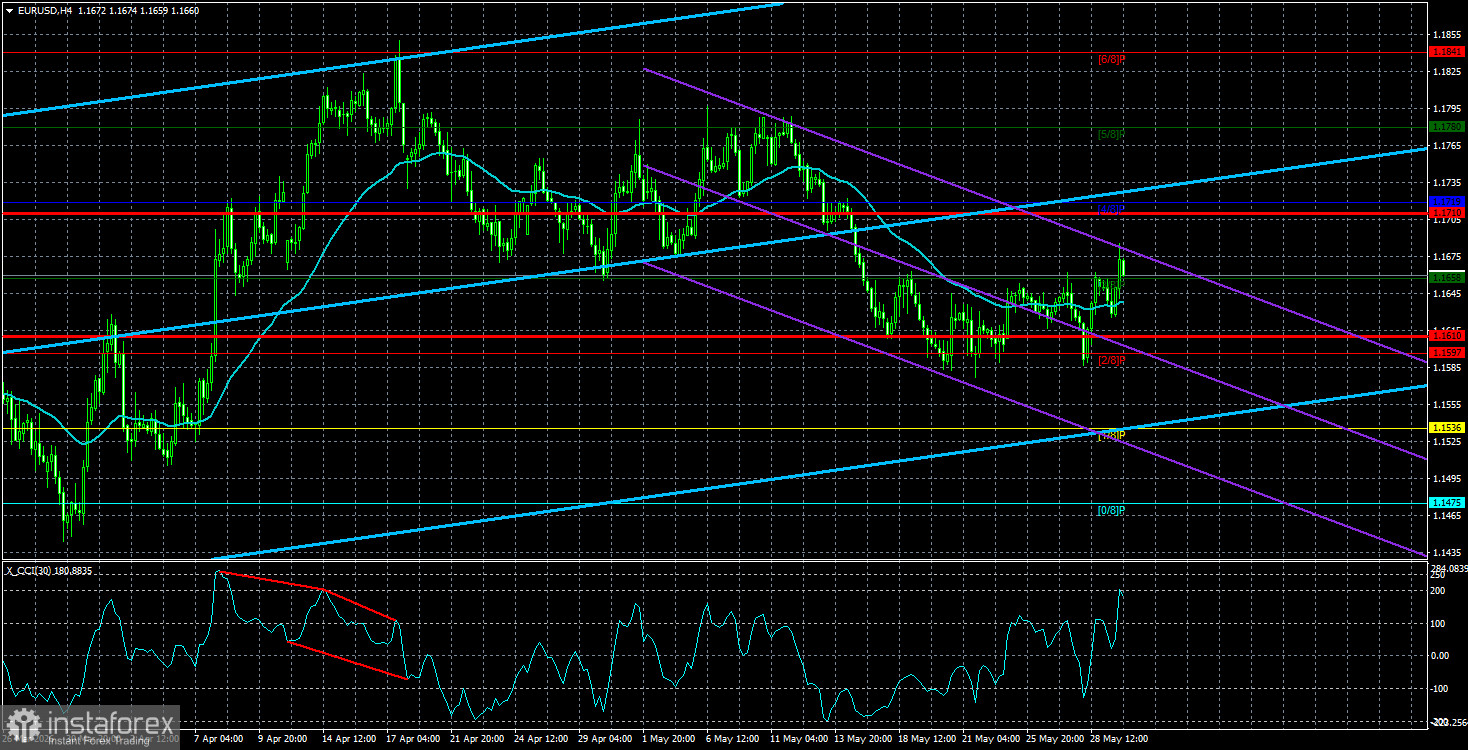
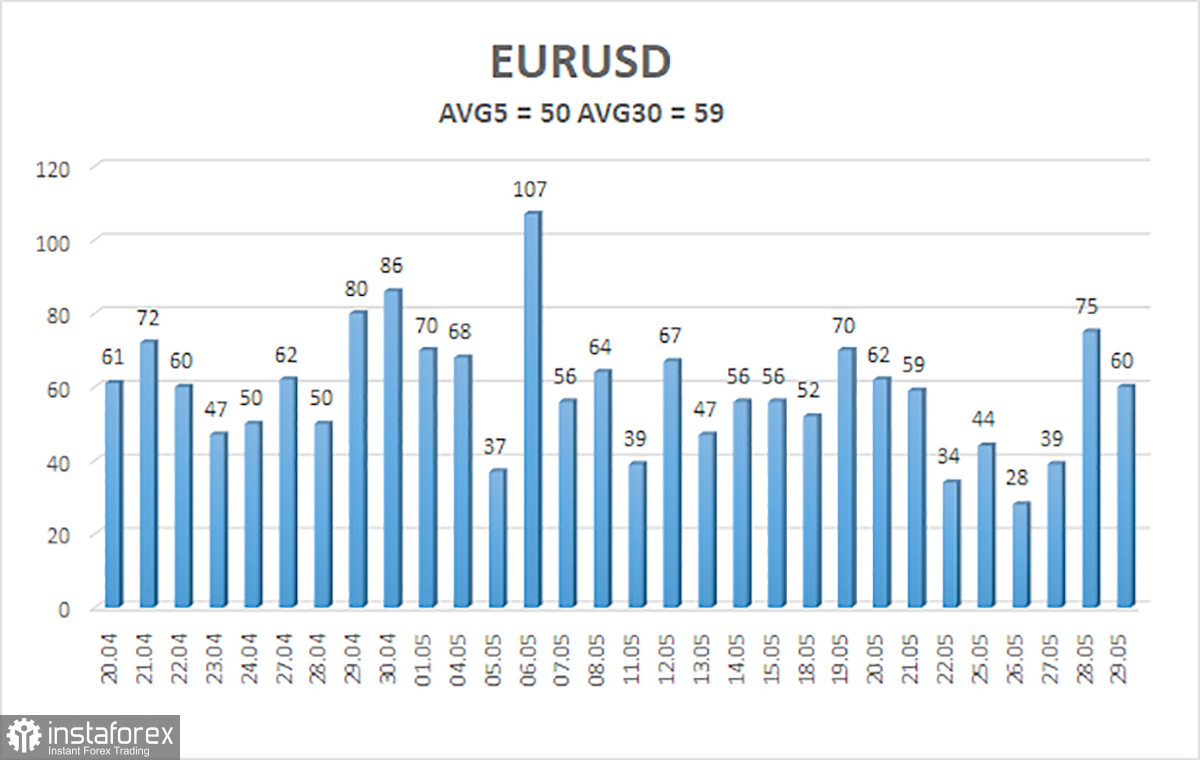
The average volatility of the EUR/USD currency pair over the last 5 trading days as of June 1 is 50 pips and is characterized as "medium-low." We expect the pair to trade between 1.1610 and 1.1710 on Monday. The upper channel of the linear regression has turned upward, indicating a trend change to an upward direction. In fact, the upward trend of 2025 could have resumed back in March. The CCI indicator has entered overbought territory and formed two "bearish" divergences, signaling the start of a downward correction that is still ongoing.
Closest support levels:
S1 – 1.1658
S2 – 1.1597
S3 – 1.1536
Closest resistance levels:
R1 – 1.1719
R2 – 1.1780
R3 – 1.1841
Trading Recommendations:
The EUR/USD pair continues its downward movement, which is presumably a correction within the framework of a global upward trend. The global fundamental backdrop for the dollar remains extremely negative, and only geopolitics regularly supports it. When the price is below the moving average, short positions can be considered with targets at 1.1597 and 1.1536. Above the moving average line, long positions become relevant with targets at 1.1780 and 1.1841. The market continues to distance itself from geopolitical factors, but the dollar has been in demand in recent weeks as hopes for peace in the Middle East have weakened.
Explanations for the Illustrations:
Linear regression channels help determine the current trend. If both are pointing in the same direction, the trend is strong;
The moving average line (settings 20,0, smoothed) indicates the short-term trend and the direction in which trading should currently be conducted;
Murray levels are target levels for movements and corrections;
Volatility levels (red lines) indicate the likely price channel in which the pair will stay over the next day, based on current volatility metrics;
The CCI indicator – its entry into oversold territory (below -250) or overbought territory (above +250) indicates that a trend reversal in the opposite direction is approaching.