Analysis of Monday's Trades:
1H Chart of the EUR/USD Pair
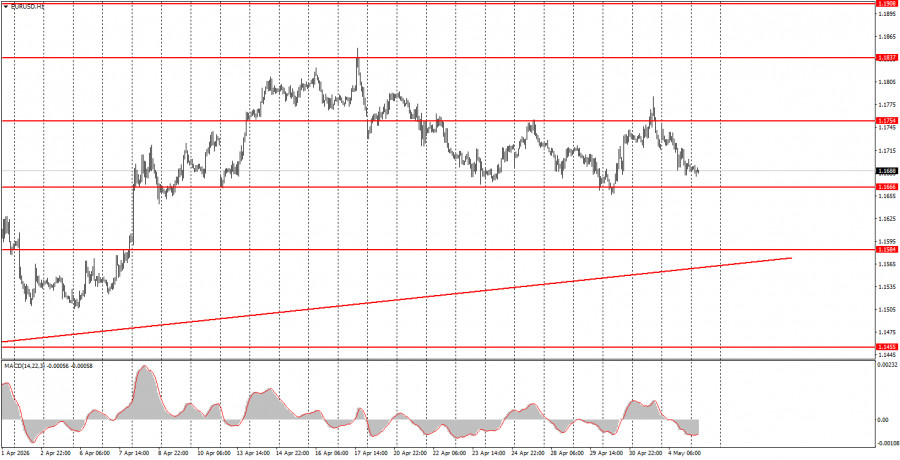
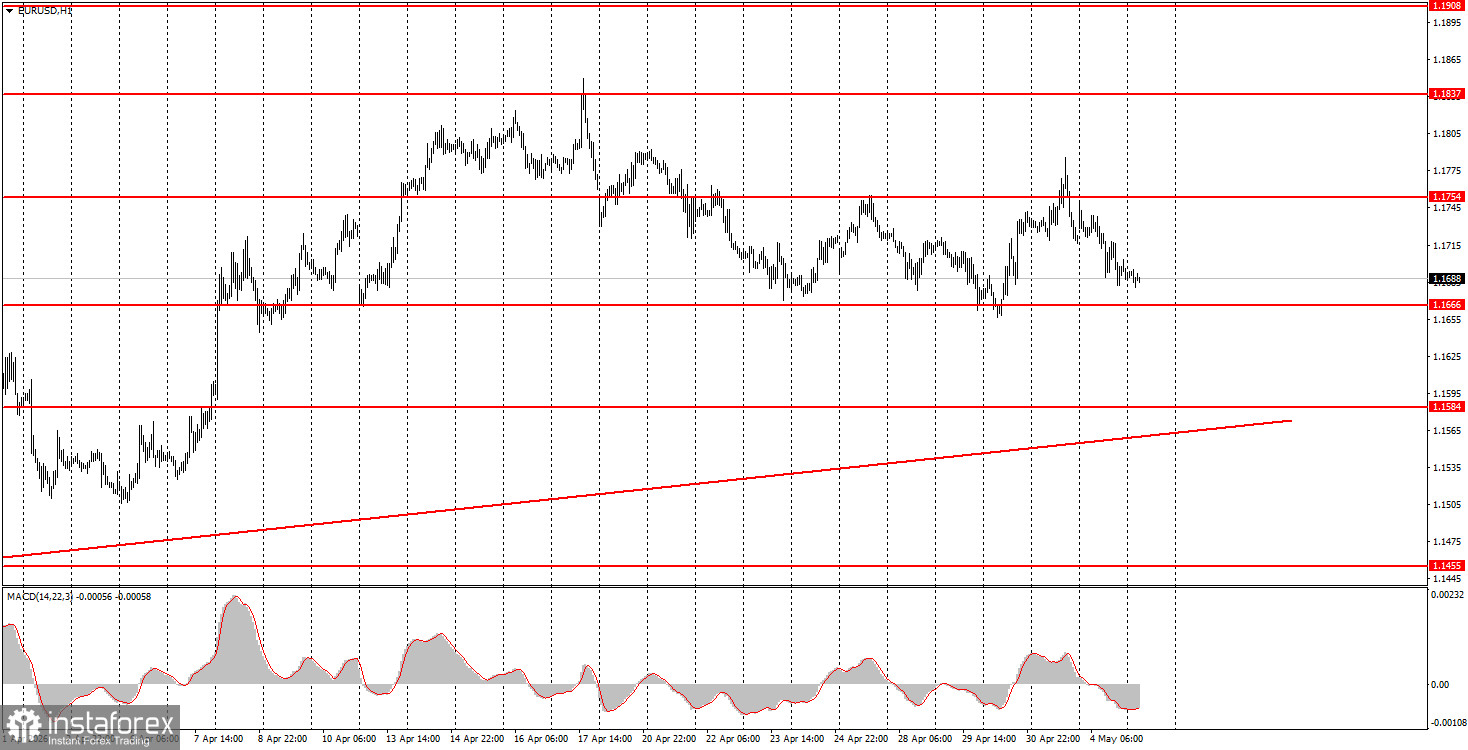
The EUR/USD currency pair continued its downward movement on Monday, which started on Friday, primarily due to geopolitical factors. The first trading day of the week was rich in various events, all somehow related to the Middle East. Around noon, it became known that an American destroyer attempted to pass through the Strait of Hormuz and was attacked by two Iranian missiles. Shortly after, Washington announced that the ship had not been destroyed and had not sustained damage. A little later, Iran launched missiles and drones toward the UAE. Following these developments, the US and Israel are preparing to retaliate against Iran, with the United Arab Emirates also readying for a counterstrike. Therefore, by the end of Monday, it can be confidently stated that the war in the Middle East has resumed, and Donald Trump will need to remove one checkbox from his list of completed wars. The US dollar responded weakly to this event. As we warned, a worsening geopolitical situation will no longer lead to the same strong increases in the American currency as seen in February and March.
5M Chart of the EUR/USD Pair
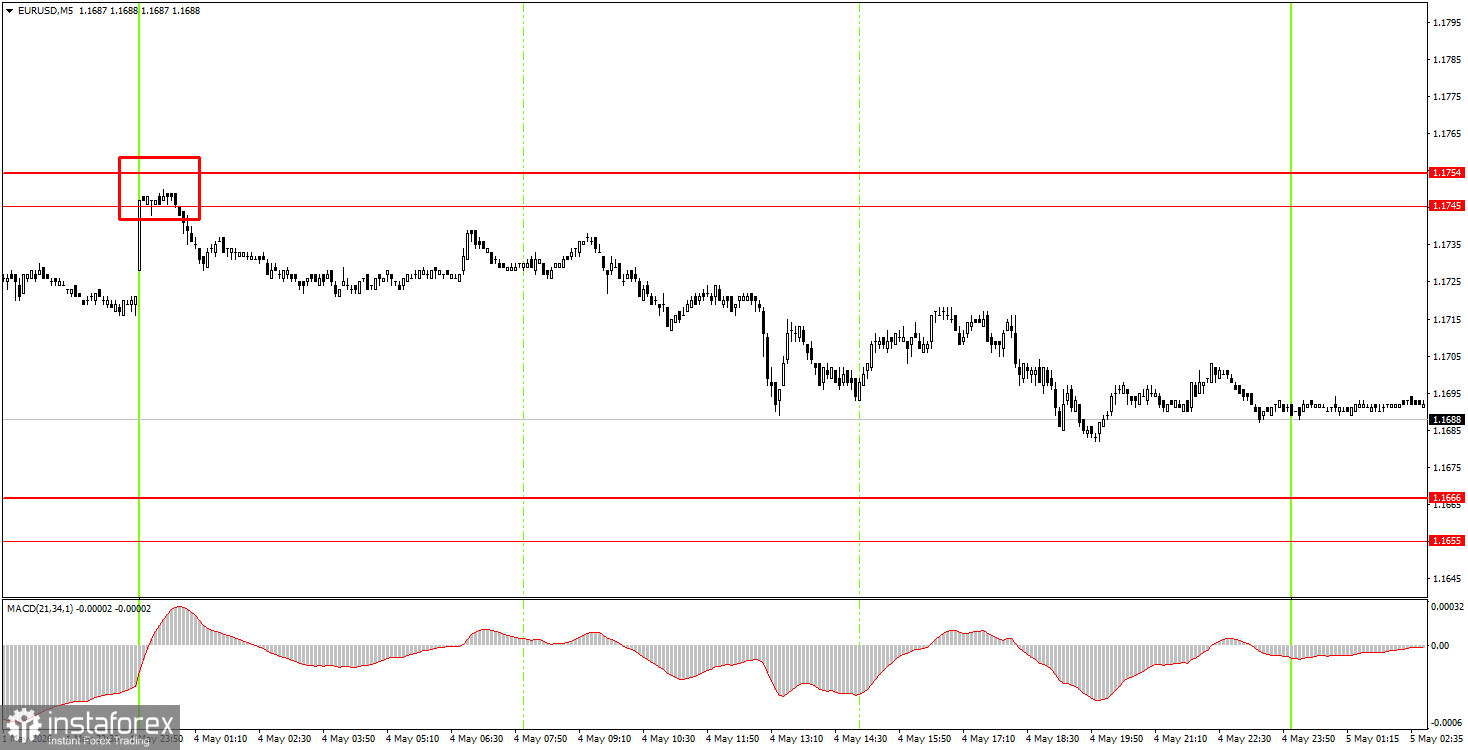
On the 5-minute timeframe, only one trading signal was formed on Monday at the market opening. The price bounced off the 1.1745-1.1754 area, and for most of the day it remained in decline. Volatility on this day was average.
How to Trade on Tuesday:
On the hourly timeframe, the upward trend remains. The geopolitical situation is not improving over time, and it could worsen this week. The world is gradually acclimatizing to the new reality in the Middle East and is seeking alternative sources of energy supplies, without much hope for a ceasefire between Iran and the US. Therefore, it is no longer worth expecting a significant strengthening of the dollar. At most, we can anticipate a continuation of the correction we have seen for the past three weeks.
On Tuesday, beginner traders may open short positions targeting 1.1584-1.1591 if the price consolidates below the 1.1655-1.1666 area. New long positions can be considered on a price rebound from the area of 1.1655-1.1666, targeting 1.1745-1.1754.
On the 5-minute timeframe, traders should consider levels such as 1.1354-1.1363, 1.1413, 1.1455-1.1474, 1.1527-1.1531, 1.1584-1.1591, 1.1655-1.1666, 1.1745-1.1754, 1.1830-1.1837, 1.1899-1.1908. On Tuesday, another speech by European Central Bank President Christine Lagarde is scheduled in the Eurozone, while the US will release the ISM and JOLTs reports. The ISM Services sector activity index is considered important, but the geopolitical events on Tuesday could easily overshadow it.
Main Rules of the Trading System:
- The strength of the signal is determined by the time it took to form the signal (bounce or breakout of the level). The less time it took, the stronger the signal.
- If two or more trades were opened near any level based on false signals, all subsequent signals from this level should be ignored.
- In a flat market, any pair can generate many false signals or none at all. Technical levels may be ignored.
- On the hourly timeframe, it is preferable to trade signals from the MACD indicator only in the presence of good volatility and a trend that is confirmed by a trend line or trend channel.
- If two levels are too close together (5-20 pips apart), treat them as a support or resistance zone.
- After a move of 15 pips in the right direction, a Stop Loss should be set to breakeven.
What is on the Charts:
Price levels (areas) of support and resistance – levels that are targets when opening purchases or sales, or sources of signals.
Red lines – channels or trend lines that display the current trend and indicate which direction is preferable to trade now.
MACD indicator (14, 22, 3) – histogram and signal line – a supporting indicator that can also be used as a source of signals.
Important speeches and reports (contained in the news calendar) can significantly influence the movement of the currency pair. Therefore, during their release, trading should be done as cautiously as possible, or one should exit the market to avoid a sharp price reversal against the preceding movement.
Beginners trading in the Forex market should remember that not every trade can be profitable. Developing a clear strategy and effective money management are key to long-term trading success.